Consultation · Sep 2026
How to Choose a Hair & Scalp Clinic in Cagayan de Oro
Seven things to check before trusting any clinic with your hair: assessments, credentials, honest timelines, hygiene, and the red flags that should make you walk away.
Scalp · Aug 2026
Scalp microneedling stimulates collagen and growth-factor release to support hair regrowth. Learn how it works, what sessions feel like, and ideal pairings.
Microneedling has moved from skincare into serious hair-restoration protocols — and for good reason. Controlled micro-injuries to the scalp trigger a wound-healing cascade that releases growth factors, improves microcirculation, and upregulates the pathways involved in follicle cycling. Used consistently, it is one of the best-supported adjunct treatments for early and moderate thinning.
A sterile device with micro-fine needles creates thousands of microscopic channels in the scalp. The body responds as it does to any micro-injury: platelets arrive, growth factors are released, new capillaries form, and collagen remodels around the follicular units. Studies pairing microneedling with topical therapy have repeatedly shown better regrowth than the topical alone — the channels also dramatically improve absorption of anything applied afterwards.
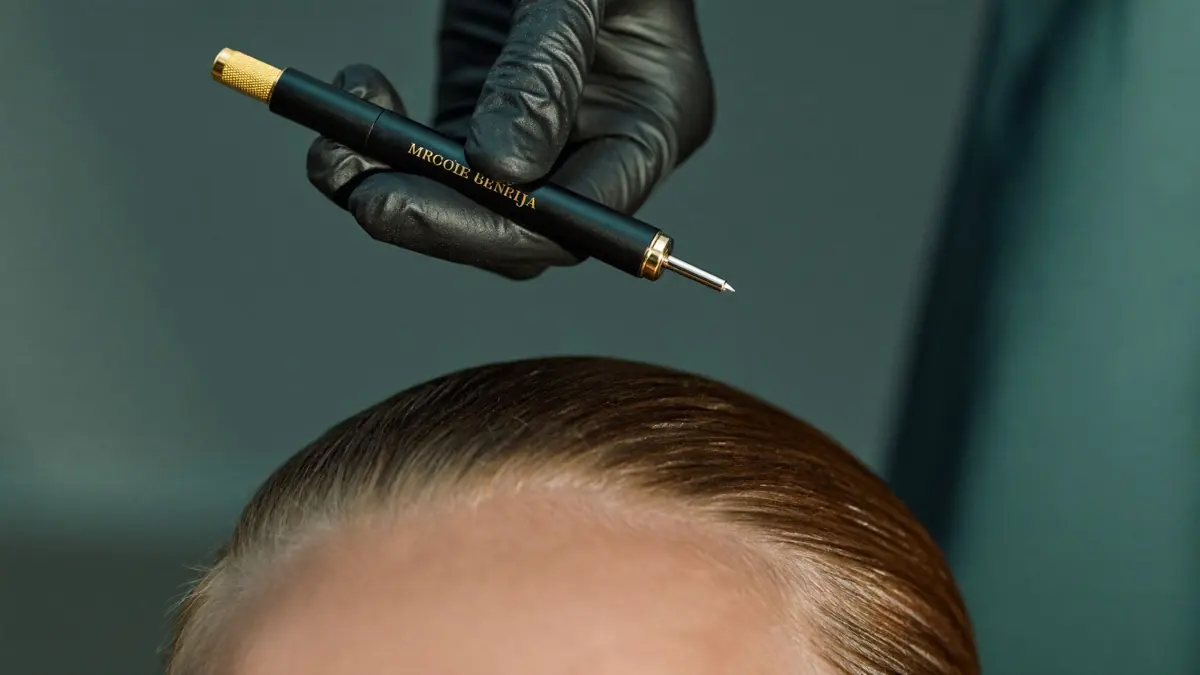
In clinic, the scalp is cleansed and sectioned, then treated systematically with a motorised pen at a calibrated depth — deep enough to trigger the healing response, shallow enough to avoid damaging follicles. A session takes 30–45 minutes, and most clients rate the discomfort as low, especially with numbing. Expect mild pinkness for a day.
Home dermarollers exist, but rolling drags needles through the skin at inconsistent depths and angles, and poorly sanitised rollers are a genuine infection risk on a sebum-rich scalp. Clinical devices stamp vertically at precise depths, are single-use sterile, and can be combined immediately with targeted serums or PRP while the channels are open — where the real compounding benefit lives.
A typical course is one session every two to four weeks for three to six sessions, then maintenance monthly or quarterly. Like all regrowth treatments, the timeline is honest but not instant: reduced shedding first, then baby hairs at the margins around month two to three, then measurable density gains from month four onward.
Anyone in the early-to-moderate stages of pattern thinning, anyone whose topical treatment seems to have plateaued, and anyone building a multi-modal plan around PRP. It is not suitable over active scalp infections or certain inflammatory conditions — which a quick scalp assessment will rule out before you start.
Consultation · Sep 2026
Seven things to check before trusting any clinic with your hair: assessments, credentials, honest timelines, hygiene, and the red flags that should make you walk away.
Hair · Sep 2026
How scalp micropigmentation works, who it suits, what sessions cost in time and comfort, and how long results last — a complete SMP guide for the Philippines.